
The correct toilet height affects not only daily comfort but also health – especially for seniors, children, or people with limited mobility. Whether installing a toilet in a new house, during renovations, or for barrier-free conversions: considering the ideal height early on avoids additional effort, costs, and compromises later.
Why is the correct toilet height so important?
In many households, the height of the toilet is often accepted without further thought – yet an unsuitable toilet height can lead to back pain or difficulty getting up in the long run. A proper toilet seat position increases well-being and significantly simplifies daily use, thus contributing to a higher quality of life – regardless of age.
Relevance in new construction and renovation
In new construction projects or complete renovations, there is an opportunity to design the WC dimensions ergonomically from the outset and to customize them individually without having to rely on expensive retrofits – be it a floor-standing WC or a wall-hung WC: The correct height plays a crucial role.
Comfort, ergonomics and accessibility
The ideal toilet height significantly contributes to ergonomics: Your feet should be flat on the floor when sitting, and your knees should be bent at a right angle. For people with physical limitations, a higher toilet with additional support – such as a toilet riser – can make everyday life considerably easier.
Impact on daily use and quality of life
The comfort of the toilet is significantly influenced by its height: if it is positioned too low, getting up becomes more difficult, and if it is positioned too high, the sitting posture may require unnecessary effort – especially in the case of shared use, a balanced center point should be found here.
For whom is the correct toilet height crucial?
The optimal toilet height isn't just relevant for seniors – it applies to almost every target group. Here we explain what different user groups should pay particular attention to.
Families with children
In family bathrooms, either children's toilet bowls with a seat height of 30–35 cm should be installed, or suitable toilet seat risers should be used. This ensures that the toilet is safe and comfortable for even the youngest family members to use without obstructing adults.
Seniors and people with physical disabilities
It is recommended that elderly people or people with reduced mobility should use a raised toilet in the range of 46-48 cm to ensure their safety and independence, preferably supplemented by grab bars or a toilet seat riser.
Large or small people
Taller people find a toilet seat height of at least 46 cm more comfortable, while shorter individuals can usually cope better with the standard height, so a height-adjustable option could be helpful.
Standard dimensions for toilets
In German households, tried and tested standard dimensions for toilets have become established, which vary depending on the type of toilet – be it a floor-standing toilet or a wall-hung toilet – and offer various adaptation options.
Standard toilet height for a floor-standing toilet
The conventional standing toilet has a seat height of approximately 40–42 cm including the seat, a dimension that is considered common in numerous apartments and houses and is usually sufficient for people without physical disabilities.

Suitable dimensions for wall-hung toilets
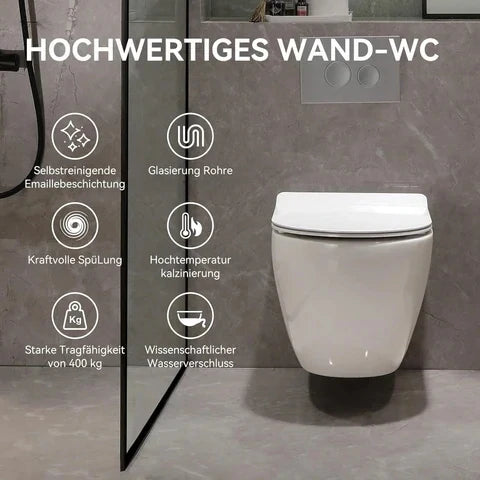
A significant advantage of wall-hung toilets lies in their variable installation height: thanks to modern pre-wall elements, the toilet height can be individually selected between 40 and 50 cm – entirely according to the user's needs. HOROW's wall-hung toilets are particularly flexible in this regard, impressing not only with their convenient height adjustability but also with their timeless, elegant design.
Accessible toilet heights according to DIN standards
Especially in accessible or age-friendly bathrooms, compliance with standards is particularly important. DIN 18040 sets clear requirements for this.
Seat height for accessible toilets
According to DIN standard 18040, the seat height for accessible toilets should be between 46 and 48 cm, including the toilet seat. These dimensions are ideal for wheelchair users, seniors, and people with physical disabilities.
Can be combined with grab handles and freedom of movement
Barrier-free bathrooms can be advantageous through the integration of grab bars and wider maneuvering areas, as well as an easily accessible flushing system – this equipment is particularly important in the context of care facilities or assisted living facilities.
Movement areas and distances
The correct toilet height is only one part of the overall concept. The surrounding dimensions also play an important role in comfort and safety in the bathroom.
Lateral distance and movement area
There should be a lateral clearance of at least 20 cm to the nearest wall or fixture. A maneuvering area of at least 60 x 80 cm should be planned in front of the toilet – ideal for barrier-free access.
Placement of accessories
The toilet paper holder should be mounted at a height of 65–95 cm and approximately 45 cm from the toilet. Additionally, the brush, flush button, and other controls should be easily accessible and user-friendly.
Toilet installation and dimensions
Depending on the type of building, the room layout, and individual needs, the dimensions and installation options for toilets vary considerably. For wall-mounted installations, such as wall-hung or suspended toilets, precise planning is crucial – not only for aesthetic reasons. The original: Especially with wall-mounted solutions like wall-hung or suspended toilets, precise planning plays a vital role – not only for design reasons.
Typical dimensions for wall installation
A modern wall-hung toilet typically has a width of approximately 36 to 40 centimeters and a depth of 50 to 60 centimeters. Including the installation in front of the wall and the cistern, this results in a total depth of about 75 centimeters. This compact design proves particularly advantageous for small bathrooms or guest toilets. Furthermore, the wall-mounted toilet's floating installation significantly improves ease of cleaning.
A major advantage of a wall-hung toilet is the possibility of individually adjusting the seating position by the variable choice of the height of the toilet seat using a suitable wall-mounting element – be it a standard seating position of about 42 cm or a raised seat surface of up to 50 cm for more comfort especially for older people or tall people.
Installation under sloping roofs is theoretically possible – provided certain minimum dimensions are met. The height above the toilet seat should be at least 145 cm to ensure comfortable use. Lower seat positions are not recommended in rooms with low ceilings, as they can make getting up difficult.
Special cases and restrictions
In reality, bathrooms are rarely uniformly designed and often have individual features – especially in older buildings or smaller living spaces, this can make the installation of a conventional toilet more difficult.
Unfavorable wall distances make the installation of a projection element difficult.
Insufficient strength of plasterboard during the installation of a wall-hung toilet.
or, due to limited space, only allows toilets with a shallow depth.
In such situations, it is advisable to collaborate with a plumbing professional during the planning phase. This expert can assess whether, for example, a shorter wall-hung toilet (from approximately 48 cm deep) or a floor-standing toilet with an integrated cistern might be a practical solution. Considering space-saving corner toilets or particularly narrow models is also recommended.
Solutions with pre-wall elements
An effective method for creating modern and functionally sophisticated toilet solutions is the use of pre-wall elements. The system integrates cisterns, brackets, and water connections onto a stable structure that is concealed behind a paneled wall.
Flexible positioning - even with non-load-bearing walls or complicated floor plans.
Modern design – the technology is subtly hidden behind the wall cladding.
Especially in accessible or age-appropriate bathrooms, the use of cladding elements and a wall-mounted toilet with a raised toilet bowl can combine both comfort and aesthetics.

Height adjustment and subsequent adaptation
If the height of a toilet is not ideally adjustable, several options are available. These range from a professional renovation to temporary solutions.
Height-adjustable toilets
Innovative technologies now allow toilets to be adjusted in height both manually and electrically – particularly useful for accessible bathrooms or in care environments.
Manual and electric systems
Manual adjustments are more cost-effective and are used in many households. Electric drives, on the other hand, offer a higher level of convenience and are particularly helpful for wheelchair users or people requiring care.
Ideal for accessible or age-appropriate bathrooms
Adjustable toilets are a worthwhile long-term investment for convenience and independence in daily life – especially important in multi-generational households.
Subsequent adjustment options
There are also straightforward ways to raise the seating position in the event of a complete rebuild.
This technique requires a lot of work and has long-term effects: it involves opening the wall to move the background element and adjusting the height of the chair; suitable only for comprehensive renovations.
Raised toilet bowl or toilet seat riser
A toilet seat riser can be a long-term option instead of using a raised toilet bowl. However, it is more cost-effective and quicker to use a toilet seat riser that simply fits onto the existing toilet seat – whether permanently or temporarily.
Tips for choosing the right toilet height
What is the correct toilet height? The answer depends on several factors – from height to living circumstances.
Try sitting down and consider your height
Before buying, it's helpful to try sitting on the toilet; your feet should be flat on the floor and your legs relaxed at a 90° angle. Doing this makes it easy to estimate which toilet height is best.
Recommendations for family and guest bathrooms
In family bathrooms, it's advisable to choose a toilet with an adjustable height or to add child-sized toilets for the comfort of little ones. Standard heights are usually suitable for guest bathrooms. If space allows, installing two toilets with different heights is also an option.
FAQ
1. What is the standard height of a toilet bowl?
The typical height of a floor-standing toilet is approximately 40–42 cm, including the toilet seat, and is considered the standard height for German households. It is designed to provide a comfortable sitting position for adults of average height. With a wall-hung toilet, the height can be flexibly adjusted thanks to the concealed cistern – a significant advantage compared to the conventional floor-standing toilet. For taller individuals or those who prefer a more comfortable sitting position, the height can be increased to 46–48 cm; this is more ergonomic and makes standing up easier.
2. What is the height of the toilet for seniors or accessible bathrooms?
For older people, people with limited mobility, and wheelchair users, there are specific requirements regarding toilet use. According to the DIN 18040 guidelines for accessible building, the seat height of an accessible toilet should be between 46 and 48 cm, including the seat itself. This height makes sitting down and standing up more comfortable and reduces strain on the knees and back. Many accessible toilets are designed as wall-hung toilets with a concealed cistern; this design allows for individual adjustment of the seat position as needed. Alternatively, existing toilets can be retrofitted with special toilet risers – either permanently fixed or portable and flexible.
3. At what altitudes are there floor-standing toilets?
Floor-standing toilets are available with various seat heights – typically, the standard height is between 40 and 42 cm, and there are also comfort toilets with a height of 46–48 cm. These higher models are particularly suitable for older or taller people, as well as households with special needs. They are also a good option for accessible bathrooms where wall mounting is not possible. Before purchasing, it is advisable to check the exact dimensions of the toilet and decide whether a fixed or height-adjustable model is better suited to your living situation.
4. How high should the toilet brush be mounted?
The correct placement of the toilet brush contributes not only to cleanliness but also to the user's comfort. It is recommended to mount the toilet brush approximately 10–15 cm above floor level – this corresponds roughly to the bottom edge of the toilet bowl. It is important to ensure that the brush is easily accessible without having to contort oneself. In the case of wall-mounted toilets or accessible bathrooms, it can be helpful to position the brush slightly higher to make it easily accessible for people in wheelchairs or with limited mobility.
5. How much space should be planned to the side and in front of the toilet?
For comfortable and accessible use of the toilet, certain minimum distances must be maintained. The lateral distances to the wall or other objects should be at least 20 cm – on both sides. A maneuvering area of at least 60 x 80 cm is recommended in front of the toilet. In accessible bathrooms, this space must be even larger to allow wheelchair users to approach. The distance to the toilet paper also plays a role: The optimal position is at a height of 65–95 cm and approximately 45 cm from the center of the seat. This ensures everything remains easily accessible and ergonomically positioned.
6. Is it possible to adjust the toilet height afterwards?
Yes, of course! There are various ways to adjust the height of the toilet. This may be necessary due to health changes or simply for comfort in old age.
Toilet seat covers are a practical and inexpensive option – they can either be permanently attached or flexibly placed on top and are usually 5–10 cm high.
Replacing your toilet made easy! When it comes to comfort, raised toilet bowls are a practical option that can be installed without extensive renovations...
Reconfiguration of the wall-mounted installation: With a wall-hung toilet, the height could theoretically be adjusted using the wall-mounted element - however, this involves additional effort, as the paneling would have to be removed and the flushing container repositioned.
Electrically controlled toilet systems are increasingly used in high-quality bathrooms - especially in barrier-free or age-appropriate designs - to allow easy adjustment at the touch of a button and thus offer maximum flexibility and comfort.


